

949strength Case Study
How a Failed 170kg Sumo Deadlift Became a Pain-Free 250kg Conventional PB Two Years Later

On 14 April 2024, at the Welsh Championships, Ieuan Barry totalled 597.5kg. Squat 210, bench 165, deadlift 222.5. He was sumo-pulling and the deadlift hurt every time he set up over it. When he came to me for his initial assessment a few weeks later he failed 170kg sumo on the floor, and was openly considering quitting the sport. The lift that should have been his strongest had become the one he dreaded most.
On 5 May 2026, twenty-five months later, at the Welsh Classic Championship, he totalled 660kg. Squat 230, bench 180, deadlift 250. Pain across the entire competition day was 0/10. The deadlift, now conventional, was the heaviest and best-looking pull of the whole prep, progressive across all three attempts. He went 9/9, weighed in comfortably under the 105kg class, and walked off the platform with a 10kg PB on his prior best total and a 62.5kg improvement on the last competition he had completed before working within 949strength.
The two-year arc is the obvious headline. The case study question is what actually changes when a lift hurts.
When a lift hurts, the cheapest intervention is to change the lift itself.
What follows is the final prep block of that arc, the two competitions that closed it, the through-line interventions that made the final block possible, and the decisions that delivered a pain-free 250kg deadlift on the platform from a lifter who had been failing the same lift, in pain, at less than 70% of that weight, two years earlier.
1. The Starting Picture
Ieuan came onto the Podium Programme in May 2024, just over a month after the 597.5kg Welsh Championships result. The initial assessment was uncomfortable reading.
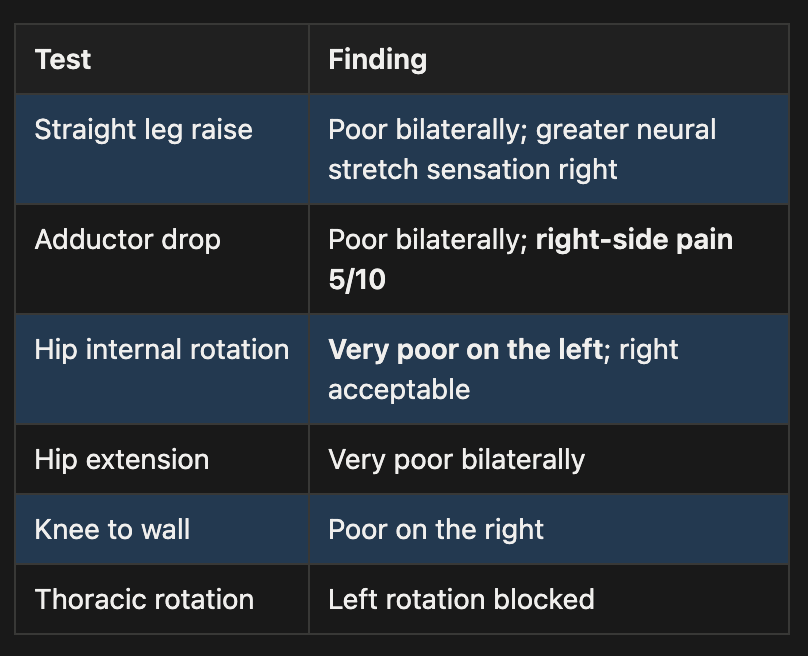
Joint Assessment (May 2024)
Strength Assessment (May 2024)
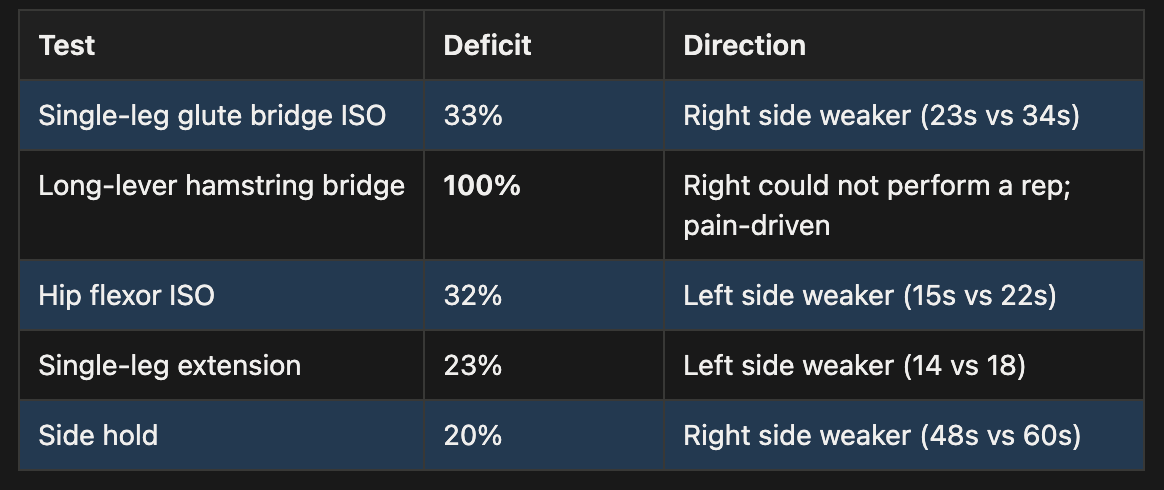
The clinical picture was a right-side load-bearing failure across the posterior chain. Right-side weakness in the glute, the hamstring, and the lateral chain. Left-side weakness in the psoas and the quadriceps. Asymmetric weakness in opposing chains around the same painful pelvis. A perfect storm around the hip.
The 100% right-side deficit on the long-lever hamstring bridge was the most extreme single test in that picture. It was pain-limited. He couldn’t perform a single rep because pain at the top of the hamstring shut the lift down. The muscle was there. He had no access to it under load. That test is the headline because it puts a number on the broader right-side posterior-chain weakness the rest of the assessment was triangulating around.
Alongside that, the adductor drop test reproduced pain at 5/10 on the right side as a joint-range finding. The 33% right-side glute bridge deficit and the 32% left-side hip flexor deficit were the next-largest strength asymmetries. The left hip internal rotation was very poor under joint range testing.
The faults that showed up in the kinograms read as strength, not mobility. The right hip externally rotated well on test and the straight leg raise was bilaterally mobile. The hip extended well on test. The collapse into the bottom of the squat and the asymmetric set-up over the deadlift were not range failures. They were failures of the right side to hold position under load.
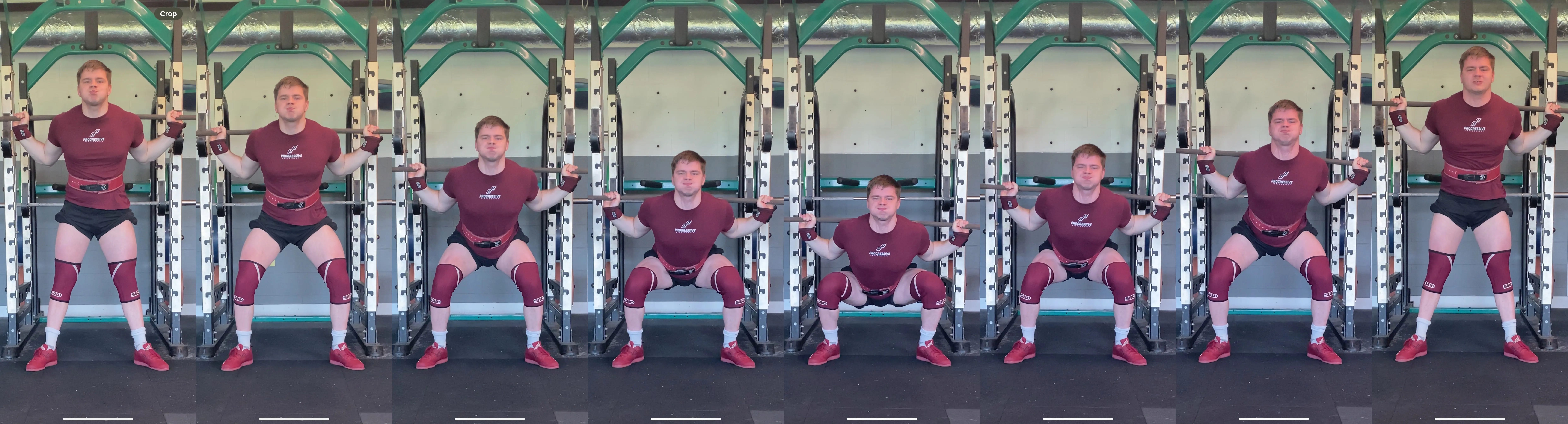
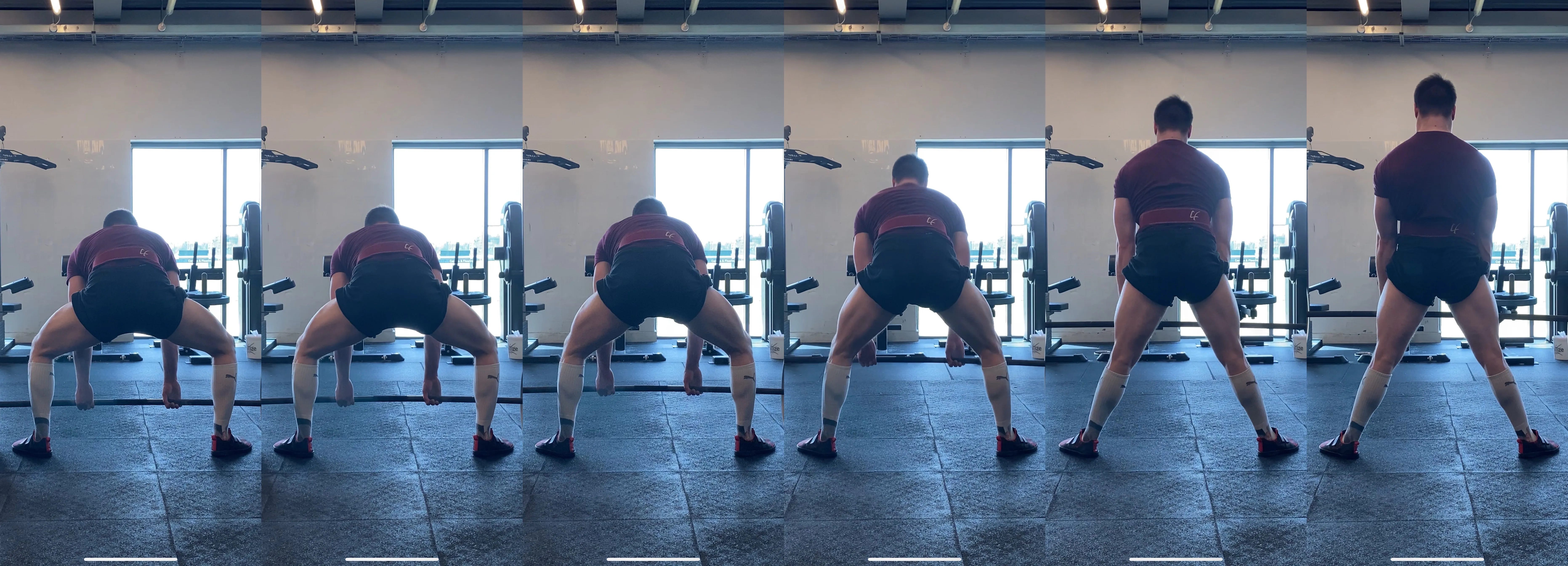
Kinograms (May 2024)
The kinograms made the assessment numbers visible. Across all three lifts the same picture played out. The right side could not carry the load. The whole pattern shifted left.
Squat. Knee-bend-first descent. The hip never unlocked into the sit-back-and-down motion the pattern needed. Limited right ankle dorsiflexion in flat shoes forced the wind-up early. The right side collapsed inward through the descent and got worse coming out of the hole. Loading shifted onto the left. The squat finished with a visible left-side lean. The right thigh looked smaller than the left on the kinogram. Hypertrophy work was on the table alongside the strength work.
Conventional deadlift. Bilateral hip extension deficit produced a non-symmetrical set position. Shoulders biased to the left. From behind, the pull was effectively one-legged. From the side, the shoulders sat slightly over the bar and lumbar position was lost through the floor break. The conventional pattern was viable. The form work was substantial.
Sumo deadlift. Same theme. The right hip could not drop. Vise onto the left through the pull. Symmetry only returned at lockout. The size difference between the legs was most obvious here. Start position was poor for separate reasons (shoulders over the bar, flexed back, hips high), and those were downstream of the right-side strength failure that was forcing the asymmetric set-up.
The coaching note logged at the time on the conventional pull was that the form issues could be addressed if he wanted to pull sumo. That observation aged interestingly. The conventional pull, not the sumo, became the pain-free 250kg platform lift eighteen months later. The 2024 kinograms read at the time as a sumo lifter with correctable conventional-form issues. They read in 2026 as the first evidence that the position the sumo pull demanded was the one the right side could not hold.
The training picture matched the assessment picture. Sumo deadlifts at 170kg were failing in setup. Squats in flat shoes were forcing a forward lean and low-back pumps that left him guarded for days afterwards. Bracing came from puffing his cheeks. Air leaked out of the belt exactly when he needed it most. Single-leg work was missing from his programme altogether.
The lifts he was performing were producing the pain he was trying to train around.
2. The Two-Year Journey to the Starting Line
The May 2024 starting picture and the February 2026 final-block starting line are connected by twenty-one months of programming decisions. Many of them were small. Three were genuinely identity-level.
2.1 Foundation (May 2024 to July 2025)
The first fourteen months were foundation work. Single-leg glute bridge. Single-leg hamstring bridge. Hip thrust progressions. RDL variants. Hip flexor isometrics. Boring, run consistently, with the May 2024 assessment results as the brief.
The trigger was the 100% right-side deficit on the long-lever hamstring bridge. This was a pain-limited finding. The muscle was there. He had no access to it under load. Adding powerlifting-specific loading on top of that picture would have aggravated the pain. The decision was to spend as long as it took on the unilateral and posterior-chain work before asking the deadlift to carry meaningful weight.
By 26 July 2025 the deficits were inside 10% across every test. The long-lever hamstring bridge was producing pain-free reps on the right side. The single-leg glute bridge was symmetrical. That was the assessment that cleared the way for powerlifting-specific work for the first time in the relationship. Fourteen months of accessory-led foundation. The investment compounds across everything that follows.
2.2 First Comp Working Together: ST Christmas Classic, 14 December 2024
650kg total. Squat 230, bench 170, deadlift 250. Sumo deadlift, clean across the day, banked while the foundation work was still mid-flight.
The decision to compete inside the foundation period was deliberate. A clean comp at this point in the rehab arc functioned as a data point. It proved that loaded competition stress could be applied to the structural picture without breaking it. The deadlift held at 250kg sumo on the platform. The hip held. The 650kg banked as a benchmark.
That benchmark stood for seventeen months. It was the number the Welsh Classic finally beat.
2.3 Welsh Championships, 24 May 2025: Underperformance and the Return of Pain
625kg total. Squat 230, bench 165, deadlift 230 sumo. A 25kg drop on the December comp. The deadlift came back grinding. The hip pinch returned at the floor pull and at the lockout. The day was an underperformance against the December benchmark and against the prep that had built it.
By spring 2025 Ieuan’s business was scaling. New clients, lead generation push, social output picking up. The pre-training discipline that had carried the first year of the relationship started to compress. Release work shortened. Activation isometrics got skipped on the busiest days. I had taken the single-leg bridge out of the programme earlier in the block on a programming call. A few weeks after the bridge came out, Ieuan wrote on his own check-in form that his deadlifts had felt worse and harder to do since it had been removed. That entry pinned the cause to a specific piece of dropped work.
The first signal of cost was the shock-week microcycle three weeks out from the comp. Bar speed dropped off heavy squats. Two top sets needed second attempts after grinding lockouts. The bench was flat. Energy and confidence were both down in the post-week debrief. The coaching read at the time was that physical, emotional, and psychological load had stacked. The instruction going forward was to ditch the session on days like that one. Willing the lift through is what produced the grinders in the first place.
The hip returned in the following block. The description Ieuan wrote in the form was specific. A pinching sensation in the right glute as he set up over the deadlift, and the same pinch holding at the lockout. Pain only in training, not outside it. The diagnostic call was that this was mechanical, hip-rotation specific, and activation specific. A mobility screen confirmed external rotation deficit on the right and tightness through the glute medius and piriformis. The interventions that went back into the programme were the ones that had quietly come out. Glute release work pre-training. Banded posterior, lateral, and anterior hip distractions before every squat and every deadlift session. Single-leg bridge isometric back in the warm-up. The dropped pieces were re-prescribed exactly where they had been.
The next decision was the mechanical taper. The deadlift was worked down through block heights, one or two inches at a time, across the final three weeks, to protect the hip from a re-flare on a floor pull in the run-in. The cost was strength stimulus. Only one floor pull went in before the comp. The trade was deliberate. Protect the hip into the platform and accept a less developed pull on the day.
Two compounding costs landed in the final fortnight. The rack pulls used for the mechanical taper drove the lower back into a facet joint irritation that needed an anti-inflammatory protocol and mobility work above and below to clear. The handler plan also fell through. The original intention had been to be on the platform with Ieuan. Brentford fixture chaos in the final two weeks made it impossible. Ieuan competed without a coach in the warm-up room.
The success of the first year had been built on a specific stack of pre-training preparation. Release work, activation, single-leg bridge, mobility before every loaded session. When that stack held, the deadlift held. When the stack came out, the hip came back. That experience was what made the late-2025 deadlift question unavoidable. Sumo had survived the foundation period only while the pre-training discipline was bulletproof. May 2025 was the first time the discipline slipped, and the right hip was the first thing to tell us what it really thought of the position.
2.4 The Deadlift Question: Late 2025
The decision to move the deadlift from sumo to conventional was made in autumn 2025. The reasoning was straightforward.
Sumo loaded the right proximal hamstring and adductor complex in exactly the wide-stance, externally-rotated, hip-flexed position that the 2024 long-lever hamstring bridge had failed in pain. Every heavy sumo pull was a small re-aggravation of the structural picture that fourteen months of foundation work had spent quieting. The pain readings were 0/10 by then, but quiet is not the same as gone. Continuing to load the position that originally produced the pain was a programming risk every prep.
Conventional changed the geometry. The right adductor came out of the loaded angle. The deadlift became a back, hip-extension, and posterior-chain expression. The pull pattern matched the strength work the foundation block had built. The cost of the change was twelve weeks of technical familiarity. The benefit was identity-level pain risk reduction.
The pattern was grooved through late 2025 and into the early 2026 prep. Pause work at the sticking region, initially at mid-shin and later relocated to just above the kneecap once the actual sticking region was clearer. Single-leg work as a constant. Bar anchoring sequence built in from the first heavy pull. The 27 December 2025 check-in flagged the genuine sticking region as just above the knee, which is where the pause work then sat.
2.5 The Qualifier and the Happy Accident: February to March 2026
The Phil Richard Classic on 7 February 2026 served as the validation comp for the conventional pull. The deadlift held up under platform conditions. The hip behaved. The 620kg total banked the qualifying number for the Welsh Classic. The Performance Review four days later locked the stance change in writing. Conventional only. No return to sumo. The detailed comp recap sits in Section 7a.
The lead-in to Phil Richard also produced the first instance of a wellness cluster signal that would later become a central load-management tool. The 11 January check-in came back with energy at 8, sleep at 4, pain at 0, nutrition on target, and motivation at 3 out of 10. Everything green except the drive. The 26 January follow-up confirmed the same picture, attributed it to work stress, and surfaced a Week 1 to Week 2 squat mismatch and a hamster-cheek bracing leak on the constrained week. The response was a sleep-routine restore and a quiet emphasis on keeping the powder dry for the platform. The dip resolved across the two following check-ins. Phil Richard ran 620kg clean three weeks after. The pattern was logged for use later.
The accident was the shoes.
On the first squat attempt, the sole of Ieuan’s flat squat shoes detached on the platform. He had been training in those shoes for years. The shoe failure cost him an estimated 10kg on the squat and cascaded into the rest of the day. He completed his attempts and kept his composure, but the equipment failure was the dominant takeaway from the day.
The opportunity was the replacement. Three weeks later, the 1 March 2026 check-in flagged a longer-standing problem with the same equipment. Flats were forcing forward lean under heavy squats and producing low-back pumps that were limiting bar position and depth. The decision came out of those two data points stacked together. Replace the shoes with the highest-heel weightlifting shoe available. The hypothesis was specifically dorsiflexion-related. The right ankle did not have the range that flats demanded. Hand the dorsiflexion requirement to the footwear, and the load that was routing through the lumbar erectors and into the right adductor should route through the quads.
The new shoes were in by mid-March. The 16 March check-in produced the data point.
Massive positive difference reported. No low-back pumps. Feels like the legs are doing more work than the back. Heeled squats showed a clear step up in mechanics — better torso position, more leg drive, less back involvement.
The stress had moved from the lumbar erectors to the quads. Knee tracking cleaned up. Depth became repeatable. The right adductor stayed quiet under heavier loading than flats had ever permitted. By the 12 April check-in the note was simple. Shoes with extra heel height are working well.
This was a hypothesis-driven response to a piece of equipment breaking on the platform. The outcome was the highest-ROI equipment change of the final 90 days of the relationship.
3. Diagnosis and Named Problems Entering the Final Block
Entering the Final Competition Prep block on 8 February 2026, these were the problems on the board.
Left hip internal rotation under load. The most persistent technical limitation across the relationship. Manageable in mobility work, but the first thing to show under heavy squat loads. The historical pattern was a left-side depth red light or a high left-side cut on heavier attempts.
Right-side strength asymmetry on hip-dominant work. The 33% glute deficit and the 100% pain-limited hamstring test were inside 10% by mid-2025, but a residual right-side strength bias remained, and right leg shake at high deadlift RPE was a recurring video flag.
Brace integrity at heavy squats. The hamster-cheek pattern had been corrected once but tended to return under genuine maximal load. Visible bracing leak meant lost intra-abdominal pressure exactly when the lift demanded it most.
Stress-driven readiness dips. A reliable cluster signal across the relationship. When energy, sleep quality, bedtime routine, motivation, mood, and stress all moved down together, training had to scale. When only one or two moved, training did not.
Attempt selection psychology. Ieuan invests heavily in competition outcomes. A bad call on the day costs more than a kilo on the bar. The attempt strategy needed to be locked before the platform.
Absent from the board was the pain that had defined the first six months of the relationship. The 5/10 right adductor pain. The failed 170kg sumo pulls. The post-squat low-back pumps. By February 2026 those problems had been replaced by the much smaller set above. Two years of work had moved the question from “how do we get this lifter loading-tolerant?” to “how do we peak this lifter for the platform?”
That shift is what made the final block possible. The pain went to zero because the lifts producing it were changed.
4. The Plan
The block was a conventional 11-to-13 week peak, restructured slightly mid-flight when the data demanded it. Foundation was effectively absorbed by the Phil Richard Classic qualifier and the post-comp deload. This was deliberate. The qualifier was the highest-quality Foundation week any compressed peak block could ask for. Three days off after Phil Richard. Two light reintroduction sessions Thursday and Friday of the following week. Full programming resumed the week after that.
The shape of the block was as follows.
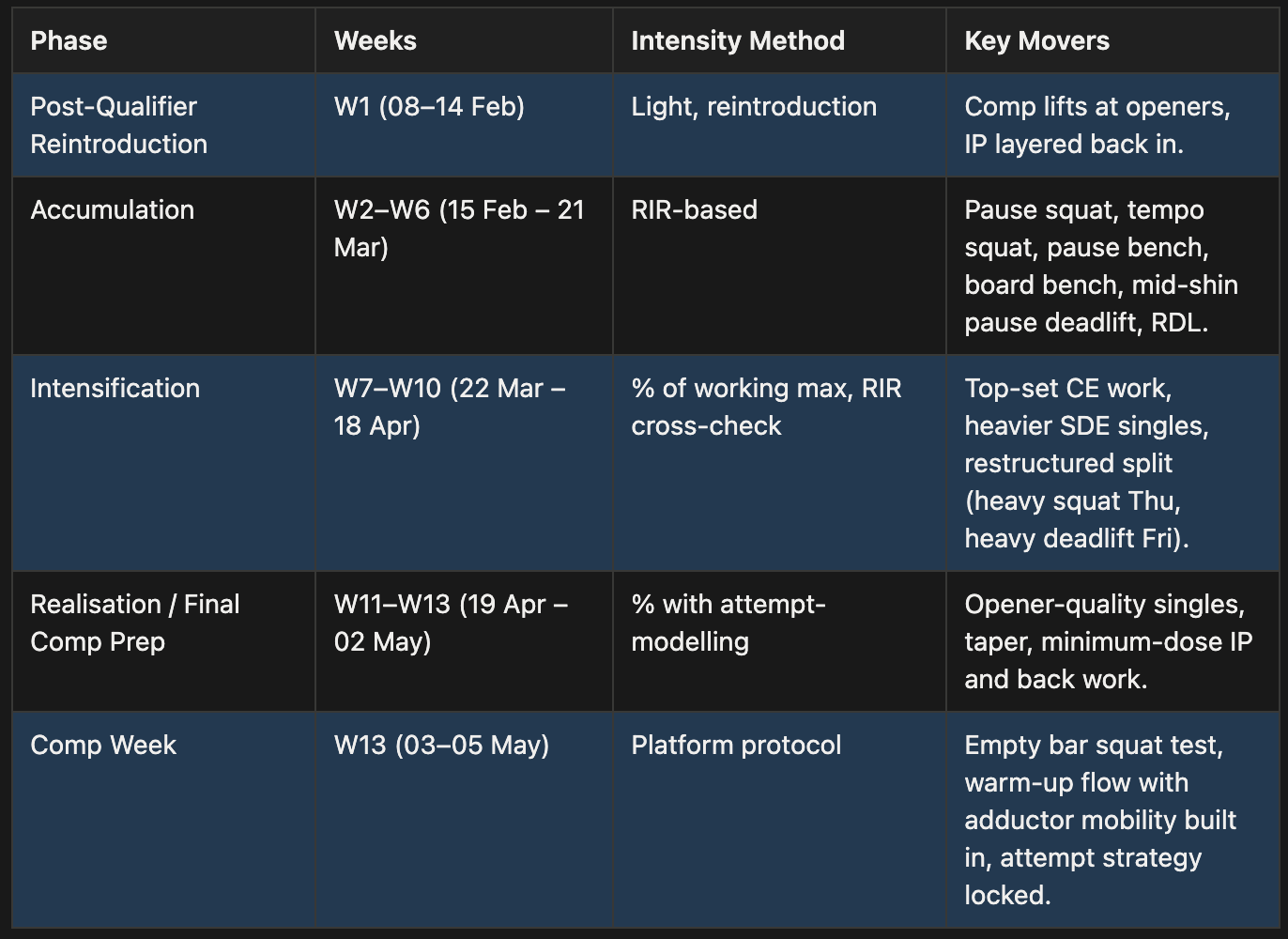
The non-negotiables built into the block were:
Higher-heel squat shoes from the mid-March 2026 changeover onward. The flat-to-high-heel transition was the late-block equipment change that came out of the Phil Richard shoe failure. By the 16 March check-in the change had already eliminated low-back pumps and moved the sensation of load from the lumbar erectors to the quads. Locked in for the rest of the block.
Conventional deadlift only. Sumo was off the table for the duration. The conventional pattern was the one that pulled pain-free and trained pain-free, and there was no programme rationale to revisit a stance that had been failing him in 2024.
Single-leg and unilateral accessory work in every relevant session. Right-glute and right-hamstring symmetry held only while this work held. Drop it and the asymmetry returns.
Air-into-belt bracing on every heavy squat. Cued in warm-up, reinforced between sets when needed.
Hip mobility and DMA work before every squat exposure. Pre-squat protocol was treated as part of the lift.
Wellness-cluster monitoring as the load-management lead indicator. If energy, sleep, motivation, and mood moved down together for two consecutive check-ins, the block adapted. If only one moved, it did not.
The explicit multi-comp strategy was straightforward and named upfront. Phil Richard was the test. The Welsh Classic was the peak. The qualifier existed to bank a qualifying total, get a real-world look at the conventional pull on the platform, and confirm the hip would hold under competition stress before committing the next three months of training to a Welsh Classic build. It did all three.
5. Execution
Phase 1: The Qualifier and the Reset (Feb 2026)
Phil Richard Classic, 7 February 2026. Squat opener at 220kg (the agreed call from the pre-comp meeting on 6 February). Bench attempts sat in the 165 to 170kg range. Deadlift ran progressively up to 230kg conventional, the first competition expression of the sumo-to-conventional switch grooved through late 2025. 9/9 in a 620kg total. The squat-shoe failure on attempt 1 (covered in Section 2.5) was the only major event of the day. Hip behaved. Pec was minor-stiff but non-symptomatic. The total was the qualifying total he needed for the Welsh Classic. Three big boxes ticked.
The post-comp deload was the four-day rest plus two light reintroduction sessions agreed in the pre-comp meeting. By the end of the week of 17 February the full programming was back on, and the Accumulation phase started in earnest.
Phase 2: Accumulation (W2 to W6)
Five weeks of higher-frequency work. Squat exposures were three a week (heavy, paused/tempo, secondary). Bench was twice a week (heavy and a paused/board variation). Deadlift was twice a week (competition pull and a mid-shin pause or RDL). The intent was straightforward. Rebuild general work capacity on the lifts after the post-qualifier reset, and start producing genuine SDE adaptation before Intensification asked for it.
The mid-March arrival of the new high-heel weightlifting shoes landed inside this phase. The 16 March check-in captured the first response. No low-back pumps. Sensation of load moving from the lumbar erectors to the quads. Knee tracking cleaner. The hypothesis had landed in two sessions. The shoes stayed in for every subsequent competition squat exposure of the block.
The check-ins through this phase were uniformly green. Energy 8–9. Sleep 5/5. Pain 0/10. Motivation 4/5. By 14 March he was reporting some of the cleanest deadlift sessions of the relationship. Squats were depth-honest most of the time and the bracing was holding. Bench had crept into rep PB territory and was looking, in my own video notes, like the strongest part of his game.
Phase 3: Intensification (W7 to W10)
This is where the block bent.
By late March the squat had crept high as load increased, and the bench had moved into a new working-load range that started to feel more expensive than usual. The 29 March feedback video was the data point. The squat depth had drifted. The deadlift was anchoring well but the right leg was shaking visibly at high RPE. The bench was up but looking slightly sluggish. The hip was holding, but the rest of the system was running hotter than the previous Accumulation phase had suggested.
Two decisions came out of that video review.
The first was a session restructure. Heavy squat moved from Monday to Thursday. Heavy deadlift moved to Friday. The previous order had been producing a Tuesday or Wednesday squat session that was carrying noticeable fatigue into the deadlift later in the week. The new order put the heaviest squat exposure away from the heaviest deadlift exposure, and gave the squat the freshest position in the week. The second was a bench cycle-down. One week back in volume and intensity, then a final push into Realisation. This was my call. The data didn’t force it. The bench was technically excellent, but the cost of further volume in W9 looked higher than the cost of one week of lighter work.
By the 11 April check-in the wellness cluster had dipped. Energy 7/10 (down from 9). Sleep quality 4/5 (down from 5). Bedtime routine 4/5 (down from 5). Motivation 3/5 (down from 4). Mood up-and-down. Stress moderate. The structural foundations stayed green. Pain 0/10, nutrition full compliance, mobility being done. The subjective layer was tracking in the wrong direction with the comp around three weeks out.
This was the second mid-block decision. Hold the line. The January 2026 dip had shown the same cluster pattern (motivation 3, sleep quality 4, routine 4) and had resolved within two check-ins as the underlying work stress eased. The same response was prescribed here. No programme cut. No emergency deload. Sleep routine restored as the highest-leverage behavioural target. Ieuan lifts with a lot of emotion and invests heavily in competition attempts, so the headspace work in the final three weeks mattered as much as anything physical on the bar. Final-prep language emphasised composure, keeping the powder dry, and trusting the work already in the bank. Two weeks later, on 25 April, the cluster had rebounded. Energy 9. Sleep 5. Motivation 4. Mood pretty good. Stress manageable. The pattern had held.
Phase 4: Realisation and Comp Week
The last three weeks were light volume, opener-quality singles, minimum-dose IP and back work, and a deliberately quiet comp-week tone. The pre-comp call on 1 May locked the openers (Squat 190, Bench 165, Deadlift 230), built the empty-bar squat test into the warm-up protocol (only escalate the opener toward 200 if the empty bar moved clean with food and caffeine on board, otherwise hold 190), and tiered the third-attempt rules in advance. Bench third attempt range pre-set at 177.5–182.5, called off bar speed at 172.5. Deadlift third at 260 only if the second moved clean off the floor. The adductor stretch and aeroplane rotation that had been used between sets in prep moved into the warm-up room flow itself.
By the final check-in, the easy 645kg total signal in training had been hit (close to his all-time 650kg PB), with the athlete’s own read that more was available on each lift. The block had landed where the data said it would.
6. The Data Story
The long-term arc and the final block read on different timescales.
The Two-Year Arc
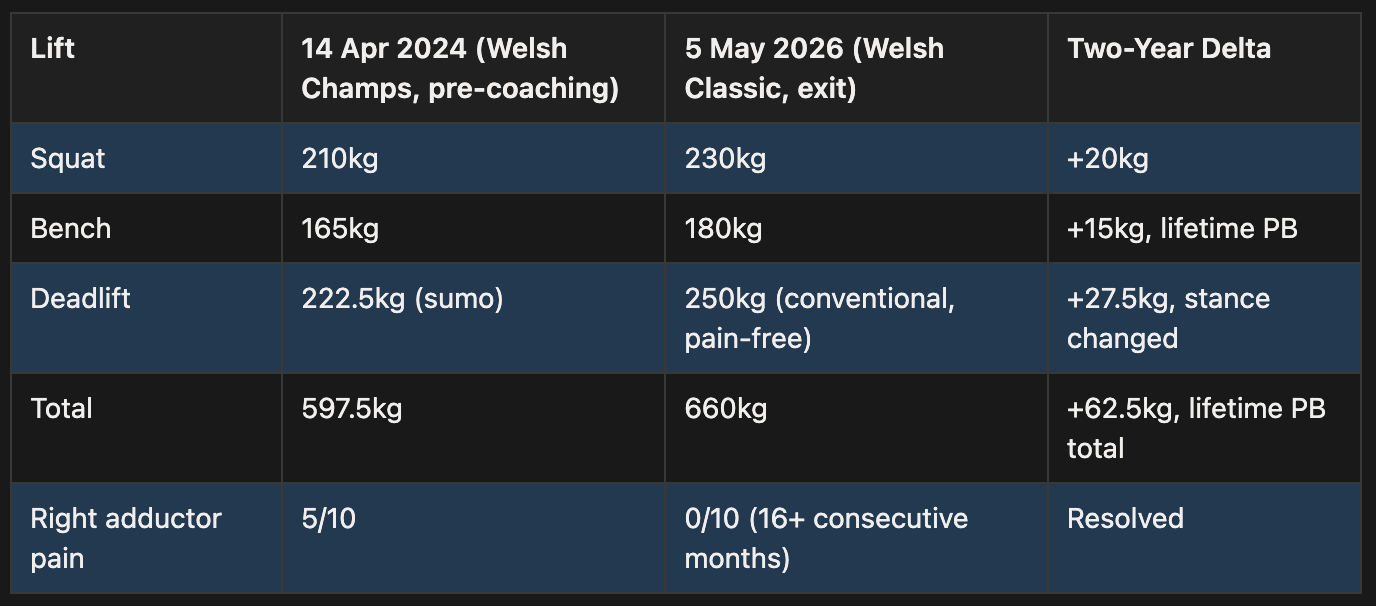
The deadlift line is the most useful number on that table. The stance changed. The pain went to zero. The lift added 27.5kg. The same pattern plays out across the rest of the total.
Lift-by-Lift Progression Across All Five Competitions
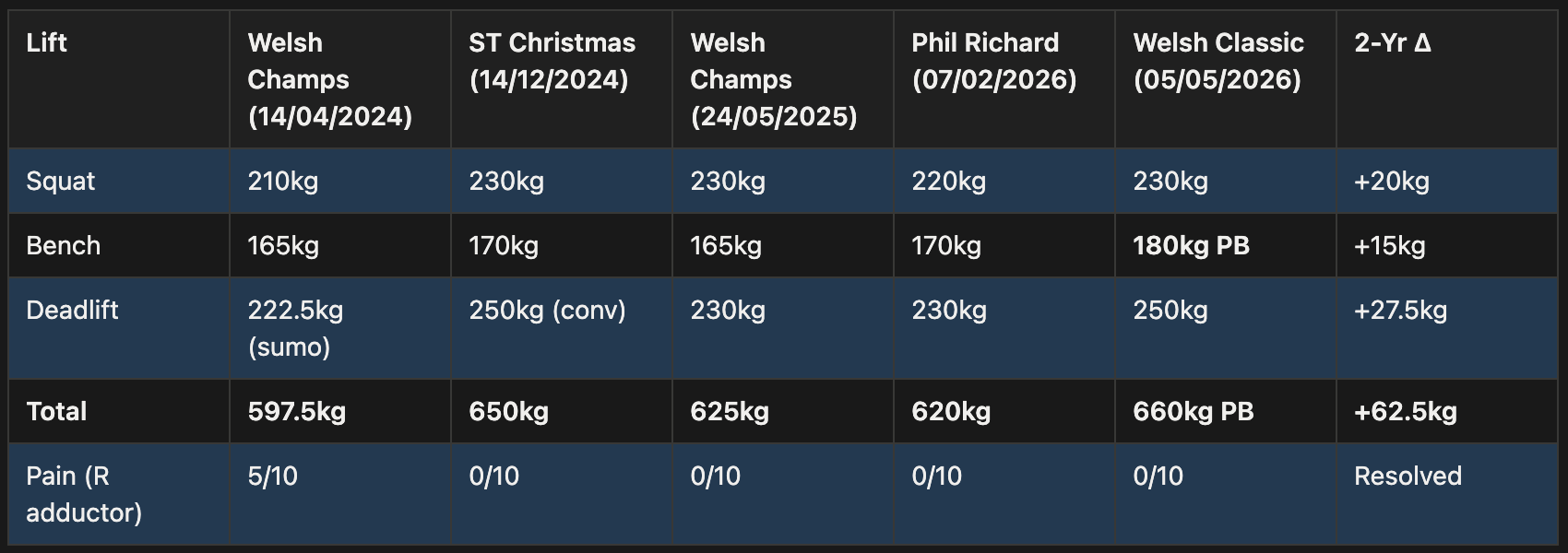
The squat held a 230kg ceiling from December 2024 onward. The bench sat between 165kg and 170kg for four competitions before unlocking 180kg at the Welsh Classic. That 180kg is a lifetime PB on the lift. The deadlift line is the noisier story. The stance change banked 250kg conventional at the first comp working together in December 2024. The lift then dropped back to 230kg sumo at the May 2025 Welsh Championships, on a day when the right hip pinch had returned and the pre-training prep stack had been compressing for weeks. Section 2.3 covers that comp in detail. The lift held at 230kg again at the Phil Richard qualifier in February 2026, this time as the first competition expression of the conventional switch and on a deliberately conservative attempt strategy. At the Welsh Classic it returned to 250kg on the platform with the cleanest pull of the entire prep.
Attempt-level data is available for the two competitions in the final block (see Appendix). Earlier competitions are recorded in the hub at best-lift granularity only.
The Final Block
The Welsh Classic prep block from February to May 2026 produced an easy 645kg in the final week of prep (close to his all-time 650kg PB), which converted to 660kg on the platform. A +15kg conversion from late-prep training total to comp total is well above the typical 1.0–1.05 ratio I see. Three things drove that conversion. Arousal management on the day. Conservative-opener / score-second / PB-third attempt template. Genuine headroom on the bench that the prep had not fully tapped.
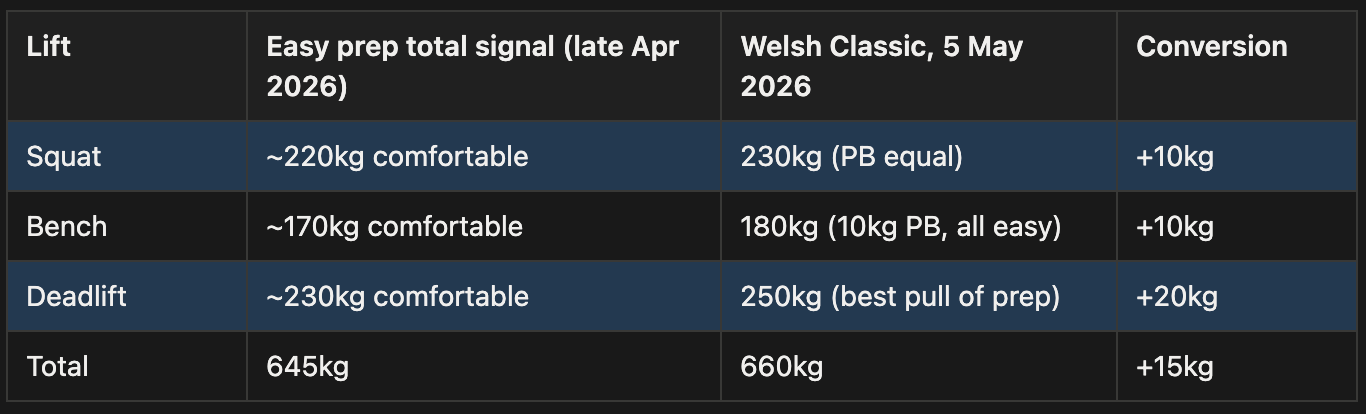
The deadlift conversion is worth a separate note. Historically, deadlift is the most pain-sensitive of the three lifts in this athlete’s history. The pre-comp data was good but conservative. The platform pull added 20kg over the comfortable-prep number and was clean across all three attempts. That is what a pain-free competition deadlift looks like for a lifter who, two years earlier, was failing the same lift in pain at 170kg.
The Wellness Cluster
The data point that most informed the block’s late-stage decisions was the readiness pattern.
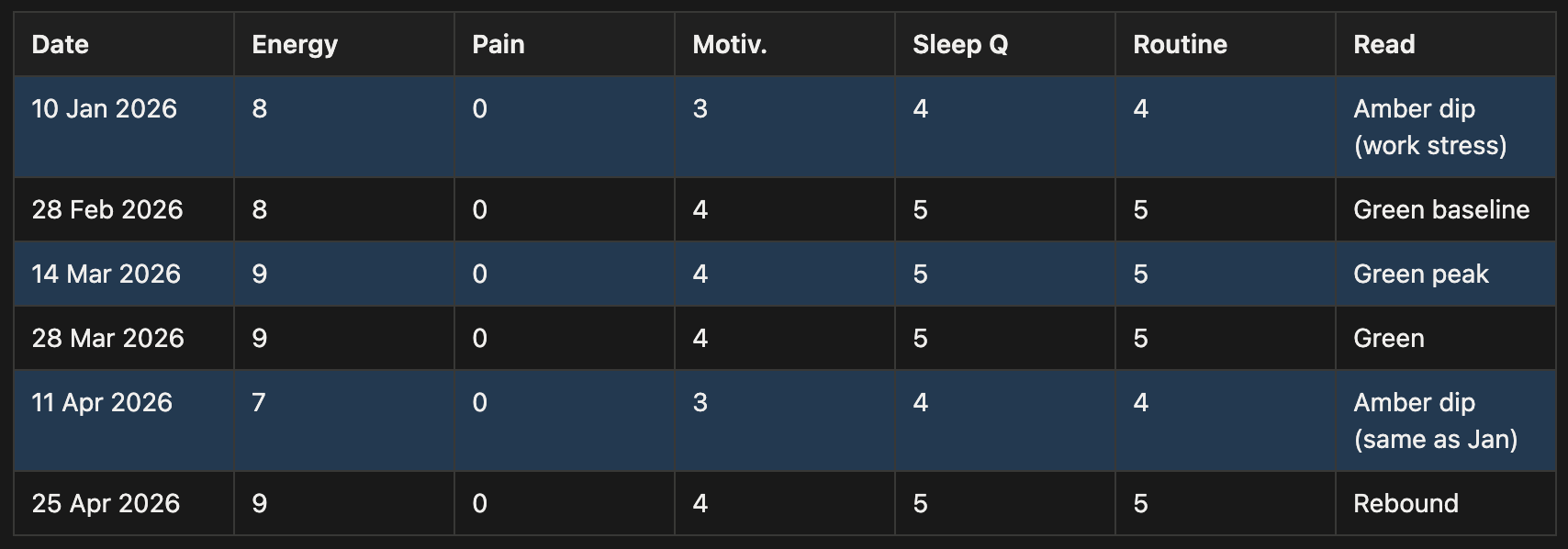
Two amber dips. Same pattern. Same resolution window (two check-ins). Pain at 0/10 throughout both. Both were attributed to work stress rather than training stress, and the resolution mechanism in both cases was the same. Sleep routine restored as the lead behavioural target, no programme cut, and a deliberate emphasis on protecting the athlete’s emotional state through to comp day. That repeatability is the reason the W10 dip did not trigger a programme cut. We had seen this signal before and we knew what it did.
7. Competition Days
7a. Phil Richard Classic, 7 February 2026 (test / qualifier)
Squat best lift 220. Bench best lift 170. Deadlift best lift 230 (the first competition expression of the conventional switch). 9/9 lifts. 620kg total. The qualifying total was banked, the conventional pull held up on the platform under real competition stress, and the hip behaved across all three lifts. The shoe sole detached on attempt 1 of one of the lifts. He kept his head, completed the lift, and the equipment lesson became a check-the-shoes-pre-comp rule going forward.
This comp existed to do three things. Confirm the conventional pull under platform conditions. Bank a qualifying total. Stay healthy. It did all three. This was a test. Ieuan’s own attempt strategy on the day was deliberately conservative against that brief. Coming off the platform with a comfortable total and a body that felt the same on Sunday as it had on Friday was the result that mattered.
7b. Welsh Classic Championship, 5 May 2026 (peak)
Squat. 230kg (PB equal, three whites).
The opener at 190kg was smooth and confident. The empty-bar test in warm-up did not produce the bar speed signal that would have escalated the opener to 200, so 190 stayed as the call. That was correct. The second at 220kg was called good (two whites) but received a depth red light on the left side from one judge. This is the historical pattern showing up exactly where it always shows up. Left hip range under maximal load. The third at 230kg was deep, three whites, grindy but never in doubt. Equalled the ST Christmas Classic 230 from December 2024, but against a much tougher build behind it.
The left adductor was stiff in early warm-ups. The mobility routine (lateral hip release, adductor release, aeroplane rotation) lived inside the warm-up flow itself. It cleared. By openers it was non-symptomatic. The warm-up protocol did its job.
Bench. 180kg (10kg PB, all attempts felt easy).
170 / 175 / 180. Three for three. Clean pause, fast off the chest, no hip lift, no command issues. The pre-set third-attempt range (177.5–182.5) was called off the bar speed of the 175 second attempt and landed at 180. The single equipment note from the day was that 3L of water consumed the day before had softened the bench pad on the Leeko rack. It produced a slightly unfamiliar feel but did not affect output. Going-forward note for any future Leeko-rack comp: factor pre-comp hydration timing relative to equipment.
The bench was the lift with the most obvious headroom remaining. 180 was not a max. The right call for the day was to bank a 10kg PB on a three-for-three comp. The bigger number could have cost a lift.
Deadlift. 250kg (PB equal, best pull of the entire prep).
Progressive across all three attempts. Each one looked stronger than the last. Bar anchoring, slack pull, and tension build were all clean. 250 was the third attempt and read as clean rather than ambitious. The pre-comp third-attempt tier rule (260 only if the second moved cleanly off the floor) ran as designed. The 250 was the right number for the day.
The deadlift, historically the most pain-sensitive lift in this athlete’s history, was symptom-free across all three attempts up to and including the 250kg pull.
Handling on the day was Ieuan’s father, who had also handled at Phil Richard. Familiar presence. Reduced novelty stress. Arousal management on the platform was excellent across the day. The 645kg easy-prep total converted to 660kg on the platform (+15kg). The conservative-opener / score-second / PB-third attempt template held on all three lifts.
8. Post-Comp Review
What Worked
Hip mobility and DMA work built into the warm-up flow. Cleared the left adductor stiffness in time for openers. Now a permanent rule for any meet on this athlete’s pattern.
Higher-heel squat shoes (mid-March 2026 changeover). Triggered by the Phil Richard shoe failure. Highest-ROI equipment change of the final 90 days. No low-back pumps. Knee tracking held. Sensation of load on the quads, not the lumbar erectors. Stay in them.
Conventional deadlift, full stop. Twenty-seven and a half kilos added to the lift, pain at 0/10 across the full block, and the cleanest-looking pull of the prep on the platform. The sumo pattern is not coming back.
Single-leg and unilateral accessory work as a constant. Right-side symmetry held under maximum loads. The 220kg depth red light was a range-under-load signal. Strength asymmetry had nothing to do with it. The single-leg work is the reason that distinction is now clean.
Wellness-cluster monitoring as the load-management lead indicator. Two amber dips inside the block (10 January, 11 April) read accurately against each other. The 11 April dip did not trigger a panic programme cut because the 10 January pattern had already given me the resolution window. Cluster signal across multiple markers.
Conservative-opener / score-second / PB-third attempt template. Worked on all three lifts at the Welsh Classic. Worked at Phil Richard. The template is the going-forward default.
Multi-comp role labelling upfront. Phil Richard as test, Welsh Classic as peak, with the block written explicitly to absorb Phil Richard as Foundation. No competing strategies. No mid-block confusion about what the qualifier was for.
What to Carry Forward and Watch
Left hip internal rotation under load remains the early signal. Any future heavy squat block that produces a left-side depth red light or high cut on the second attempt should restore L-priority internal rotation work before adjusting load.
Bracing reinforcement. Air-into-belt holds while the cue is reinforced periodically. Drop the cue for a block and the hamster-cheek pattern returns. Practise away from heavy lifting whenever bracing feels off.
Bench is now an open question. The lift has clear headroom remaining and is the most technically dialled of the three. The limiting factor going forward is loading exposure. The skill is in place.
Watch the wellness cluster. Scale load only when energy, sleep, and motivation move down together. A single-marker dip can pass on its own.
What to Retire
Sumo deadlift. Not under any circumstance.
Flat squat shoes. Redundant for the competition pattern.
The pre-coaching brace. Cheek bracing leaks intra-abdominal pressure exactly when the lift needs it.
“Single-marker readiness dip = scale load” thinking. Replaced with cluster-dip detection. A single-marker dip can pass on its own.
9. The Principle: Change the Lift Itself
The cheapest intervention for a painful lift is to change the lift itself.
Most lifters, when a lift hurts, reach for the load-management toolkit first. Load less. Rest more. Stretch harder. Rehab in isolation. All four are useful. The identity-level change to the lift itself is the move that locks the pain out for good.
It applies to Ieuan’s deadlift, which moved from sumo to conventional and added twenty-seven and a half kilos pain-free. It applies to his squat, which moved from flats to a higher-heel shoe and eliminated the low-back pumps that had been guarding his sessions. It applies to his bracing, which moved from cheeks to belt and unlocked the intra-abdominal pressure he needed under maximal loads. Each of those changes is identity-level. The lift after the change is not the same lift as the lift before the change. The pattern, the position, and the demand on the system are different.
Load management and rest are reversible. You can deload for two weeks and then return to the same pattern that was producing the pain. The pain returns with it. Identity-level technical change is, in practice, not reversible. Once a lifter has spent eighteen months pulling conventional and getting strong at it, they do not go back to sumo. Once a lifter has spent twelve months squatting in higher-heel shoes and stops getting low-back pumps, they do not go back to flats. The change locks in. The pain stays out.
Identity-level change carries a cost. It costs technical familiarity. It costs short-term performance, because a new pattern is always worse than a familiar one before it is better. It costs ego, because telling a lifter their current pattern needs to change is harder than telling them to deload for a week. Most of the resistance to this principle is paid in those three currencies.
The coaching question that follows is which change, which lift, and when. For Ieuan, those answers came at different points across the arc. Sumo to conventional was decided in autumn 2025 and locked in at the Phil Richard Classic. Flats to high-heel was the March 2026 happy accident that came out of a piece of equipment breaking on the platform. Cheeks to belt was a 2025 cue-level change reinforced into the final block. The sumo-to-conventional change cost twelve weeks of technical familiarity on the deadlift. It bought a 250kg pain-free pull on the platform.
That is the trade I want every lifter reading this to consider. If a lift hurts, and the pain has outlasted the standard load-management answers, the next move is a change to the lift itself. The change that fits the lifter’s structure, addresses the specific pattern producing the pain, and is held long enough to stop being new. Two years later you find out whether the trade was worth it. For this lifter, the answer is on the platform.
P.S. If a lift has been hurting for longer than the load-management answers should have fixed it, the next change worth trying is the lift itself. If you’re working through that question, or you coach a lifter who is, I’d love to help. Visit the website to schedule a consultation.