

Inversion Thinking
Part Of The Mental Model Series In Powerlifting


Every lifter hits the same wall eventually. Progress stalls, and the instinct is to add. More volume. More accessories. More complexity. The assumption is that the gap between where you are and where you want to be gets filled by stacking more on top.
But what if the two or three things actively holding you back are already in your programme, or your habits, and the fastest route forward is removing them?
That’s Inversion. A mental model that starts with one question: “What’s guaranteeing I stay stuck?” Once you start asking it, you’ll find subtraction opportunities everywhere.
What Inversion Actually Means
Inversion is a problem-solving approach that starts with the question: “How would I guarantee failure?”
Most people default to forward thinking. They ask how to get stronger, how to add muscle, how to peak for a competition. These are useful questions. But they miss an entire category of problems. The ones hiding in plain sight. The sleep debt. The skipped warm-ups. The 5kg weekly jumps that ignore bar speed. Forward thinking assumes you need more. Inversion asks what you need to remove.
The mathematician Carl Jacobi built his career on this principle. His advice was simple: “Invert, always invert.” Charlie Munger popularised it in investing: “It is remarkable how much long-term advantage people like us have gotten by trying to be consistently not stupid, instead of trying to be very intelligent.”
Consistently not stupid. That’s the whole game. Systematically removing the things that guarantee you stay stuck.
Most self-coached lifters spend 90% of their mental energy on the forward question. What programme should I run? What accessory will fix my lockout? Should I add a fourth bench day? These are fine questions, but they ignore the problems you’re creating for yourself.
The biggest threat to your progress is rarely a missing exercise. More often, it’s a habit you already have.
The Podium Program Already Runs on Inversion (We Just Never Named It)
Here’s something I realised while writing this newsletter. The entire Podium Program is built on inversion thinking. Good coaching, when you strip it back, works this way naturally.
The Deep Dive Assessment
Every lifter who joins the Podium Program starts with a deep dive assessment. Joint screen. Strength screen. Technical screen. Three separate evaluations before a single session is programmed.
The question those assessments answer is: “What’s currently broken, weak, or restricted that will hold this lifter back if we don’t address it first?”
That’s the inverted question. Every coach asks what to train. We ask where the lifter is vulnerable. The difference matters, because the answer changes everything about the foundation phase.
The assessment runs through three screens. A joint screen that maps bilateral mobility restrictions. A strength screen that profiles isometric and through-range capacity across the hip extensors, hip flexors, adductors, lateral trunk, and posterior chain. And a technical screen that films all three competition lifts from four angles and builds kinograms to track movement quality over time.
Each screen exists to surface hidden risks.
The joint screen might flag a left hip internal rotation restriction paired with pain on provocation. The strength screen might reveal a single-leg glute bridge hold of 53 seconds on one side and 80 on the other, or a hamstring bridge asymmetry where one leg gives out at 13 seconds and the other holds for 36. The technical screen might expose a hip shift under load that doesn’t appear in warm-up sets.
None of these are things a lifter walks in complaining about. They’re invisible asymmetries. The kind that don’t cause pain today but guarantee compensation patterns, stalled progress, or injury six months from now.
From there, the cascade framework traces each deficit upstream to its cause and downstream to its consequences. A hip restriction doesn’t just affect the squat. It can inhibit glute max, compromise the posterior oblique sling, reduce force closure at the SIJ, and overload the erector spinae. One restriction creates a chain of compensations. The assessment identifies the chain. The programme breaks it.
The entire foundation phase gets built around eliminating those failure paths before touching competition-specific intensity. Every exercise is tagged to a specific deficit. Every progression is gated by the assessment improving. 6-8 weeks of targeted IP work in every session, daily mobilisation drills, extra sets on weaker sides. All driven by what the screens flagged.
I’ve watched this approach consistently outperform programmes that jump straight into heavy competition lifts. A lifter who spends eight weeks closing a 34% hamstring bridge deficit and a hip rotation restriction enters their first intensification block with a foundation that holds. A lifter who skips that work and chases numbers from week one hits a wall by week twelve. The assessment buys time upfront and saves months on the back end.
This process scales to everything else we do. Attempt selection at competitions follows the same logic. Most lifters walk into a comp asking “What’s the biggest total I can hit?” That’s forward thinking. It leads to ambitious openers, pre-planned thirds based on gym lifts, and aggressive jumps fuelled by adrenaline.
We flip that question. “What attempt strategy would guarantee a bomb-out?” The answers come quickly. Opening too heavy. Chasing numbers you’ve never touched in training. Jumping 5kg between attempts because the crowd is loud. Once you’ve listed those behaviours, you build the opposite. Conservative openers at 88-90% of training max. Reactive second attempts based on how the opener moved. Third attempts decided in the moment.
Our core training philosophy bakes the same principle into day-to-day programming: “Avoid training to failure consistently. Constantly training to complete failure destroys form and recovery. Focus on executing reps well.” That’s an inverted principle at the foundation of everything we programme. We cap RPE. We programme deloads. We track RIR. We’ve already answered the question of what would guarantee a lifter breaks down, and we’ve removed it from the plan.
Why Self-Coached Lifters Need This More Than Anyone
When you have a coach, someone else is running the inversion for you. They’re watching your technique drift. They’re flagging your sleep patterns in check-ins. They’re pulling you back when you want to push through pain.
When you’re self-coached, nobody is asking the inverted questions on your behalf. Which means you have to build the habit yourself.
The most common pattern I see in self-coached lifters who stall is this: they add complexity in response to plateaus. More sets. More variations. A new periodisation model. Maybe bands and chains. Maybe a coach on Instagram has a “secret” protocol.
I see it constantly. A lifter’s squat has flatlined for three months, so they bolt on pin squats, belt squats, leg press, and an extra session. Six weeks later they’re more fatigued, their technique has drifted, and the number hasn’t moved.
The problem was never a lack of volume. They were sleeping 5.5 hours a night, skipping warm-ups, and jumping 5kg per week regardless of how the bar moved. Three fixable behaviours. Zero of them required a new exercise.
Adding complexity on top of a broken foundation accelerates the problem. You end up further from the answer, not closer to it.
The Inversion Audit: A Tool You Can Use Today
Here’s a framework you can use at the start of every training block. Takes ten minutes. Write your answers down.
Goal for this block: (specific, measurable, time-bound)
Three things that would guarantee I fail at this goal:
Which of these am I currently doing (even partially)?
One guardrail for each
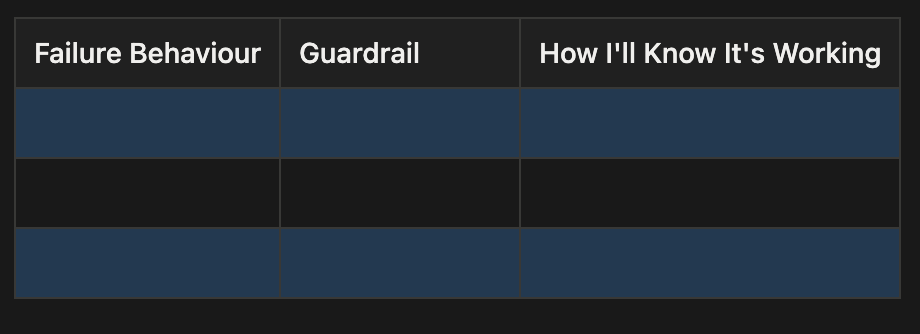
Review date: (4-6 weeks from now)
Fill this in before your next block starts. Pin it somewhere visible. When progress stalls mid-block, check the guardrails before you change the programme.
To give you a sense of what this looks like in practice, here’s a real example based on patterns I see across the Podium Program roster
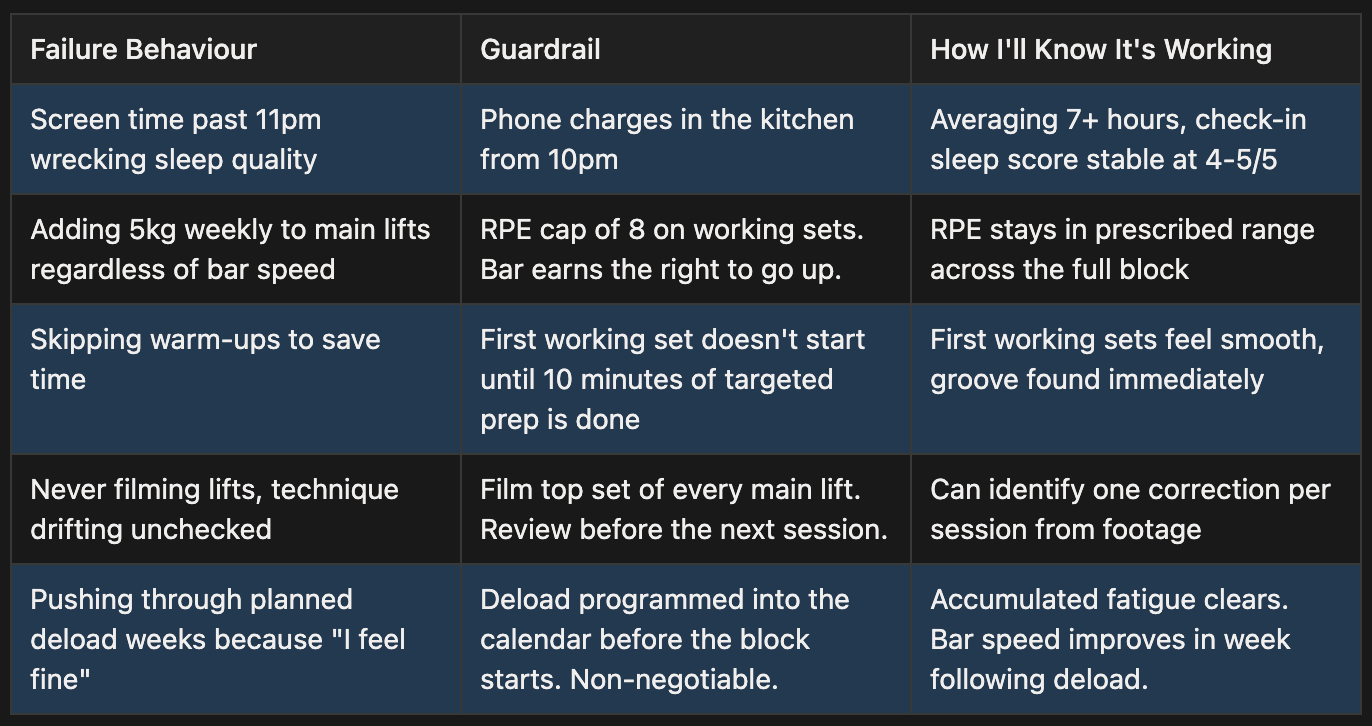
I’ve seen lifters break through months-long plateaus by fixing one of these guardrails and changing nothing else in their programme. Sleep is the most common one. It’s also the one lifters are most resistant to addressing, because it feels like it shouldn’t matter as much as it does.
Where Else Inversion Applies
Once you start thinking this way, you see it everywhere.
Planning a competition peak? Invert it. What would guarantee you underperform on the platform? Training too heavy too close to comp day. Cutting weight aggressively in the final week. Choosing ambitious openers based on gym lifts under ideal conditions. Missing the taper window. Each of these is preventable.
Choosing a new programme? Invert it. What has caused your last three programmes to stop working? If the answer is always the same thing (you pushed too hard in weeks 5-6, you skipped the accessory work, you didn’t adjust for life stress), then the programme was never the problem. Your execution pattern was.
Got an unplanned holiday coming up? Invert it. What would guarantee you come back worse? Panicking about missed sessions and cramming a rushed workout in a hotel gym with bad equipment and no warm-up. Trying to “make up” the volume by doubling up sessions the week you get back. Abandoning your nutrition targets because you’re “off plan anyway.” Once you list those behaviours, the answer is obvious. Take the days off. Keep protein reasonable. Move if you feel like it, but don’t force a training session that does more harm than good. A few days of rest has never derailed a block. A tweaked back from a dodgy hotel gym rack has.
Managing an injury? Invert it. What would guarantee you lose all your progress? Stopping training entirely. So you build a Plan B that maintains neural drive and movement quality while working around the constraint. That’s exactly what Dan Pfaff’s Plan B methodology does. It’s the framework we use at 949strength when a lifter needs to train around pain. Stay as close to Plan A as possible. Eliminate the behaviours that would guarantee regression.
Inversion turns your experience into a decision filter. Every mistake you’ve made becomes a guardrail for the future.
Key Takeaways
Inversion starts with failure. Ask how you’d guarantee a bad outcome. Then eliminate those behaviours one by one.
The 949strength assessment process is inversion in action. The joint screen, strength screen, and technical screen all exist to surface hidden vulnerabilities before they become real problems.
The 9-for-9 philosophy applies inversion to competition. List everything that would guarantee a bomb-out. Build your attempt selection to avoid all of it.
Most plateaus have a subtraction solution. Removing one harmful behaviour often unlocks more progress than adding three new exercises.
Guardrails beat willpower. Design systems that make failure behaviours harder to repeat. Phone in the kitchen. RPE caps. Filmed sets. Scheduled deloads.
Audit regularly. Old habits resurface under stress. Check your failure list every 4-6 weeks.