

Partial ROM Training
Where did it go?

If you were to look through most lifters’ feeds nowadays, there’s one thing you’ll see very little of, or nothing at all.
Partial range of motion training.
I think it may be associated with equipped lifting only due to the requirements of training in equipment (especially the equipped bench press). Potentially seen as ego lifting that doesn’t transfer, as you can lift heavier weight than through full range, and that training with partial ranges is not ‘specific’ enough?
These are my assumptions of why it isn’t used, that may not be the case, maybe lifters just don’t know enough about the method to factor it in succesfully?
But they have a rich history in strength training.
A Brief History
One of my favourite strength training stories from the old school lifters is Paul Anderson’s hole in the ground.
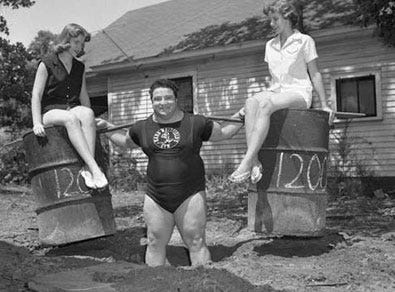
In the 1950s, Anderson would dig a hole in his backyard, set a barbell across the top, and squat from the bottom position. Each day he’d fill in a little more dirt, progressively increasing his range of motion while the load stayed the same.
The methodology was simple: if I can put a greater amount of weight on my back and lift it through a partial range, then I’ll add range over time. It’s the opposite of how most lifters think about progressive overload, same range, more weight.
Anderson flipped it: same weight (or more), progressively greater range.
The result? Anderson reportedly squatted 1,200 pounds (544 kg) in training and performed numerous reps with 800-900 lbs. He famously used a specially made 1,160-pound barbell filled with silver dollars for public demonstrations.
Now, most of Anderson’s legendary lifts were performed as a professional strongman in exhibitions, not official competitions. Powerlifting as a sanctioned sport with standardised rules didn’t exist during his peak amateur career in the mid-1950s. His heaviest official squat was 929 lbs (421 kg) in 1965, which still stood as the heaviest raw squat record for over a decade.
Either way, his method was crude but effective, targeted overload at specific positions, then expansion outward.
Bob Peoples applied similar principles to the deadlift. In the 1940s, Peoples pulled 725 pounds at a bodyweight of just 185 pounds—a feat that would be remarkable even today. His training included heavy rack work and partial pulls to develop pulling strength at specific positions in the lift.
Russian Weightlifting and Special Exercises
The Soviets took a more systematic approach. Russian weightlifting methodology classified exercises by their relationship to the competition movement.
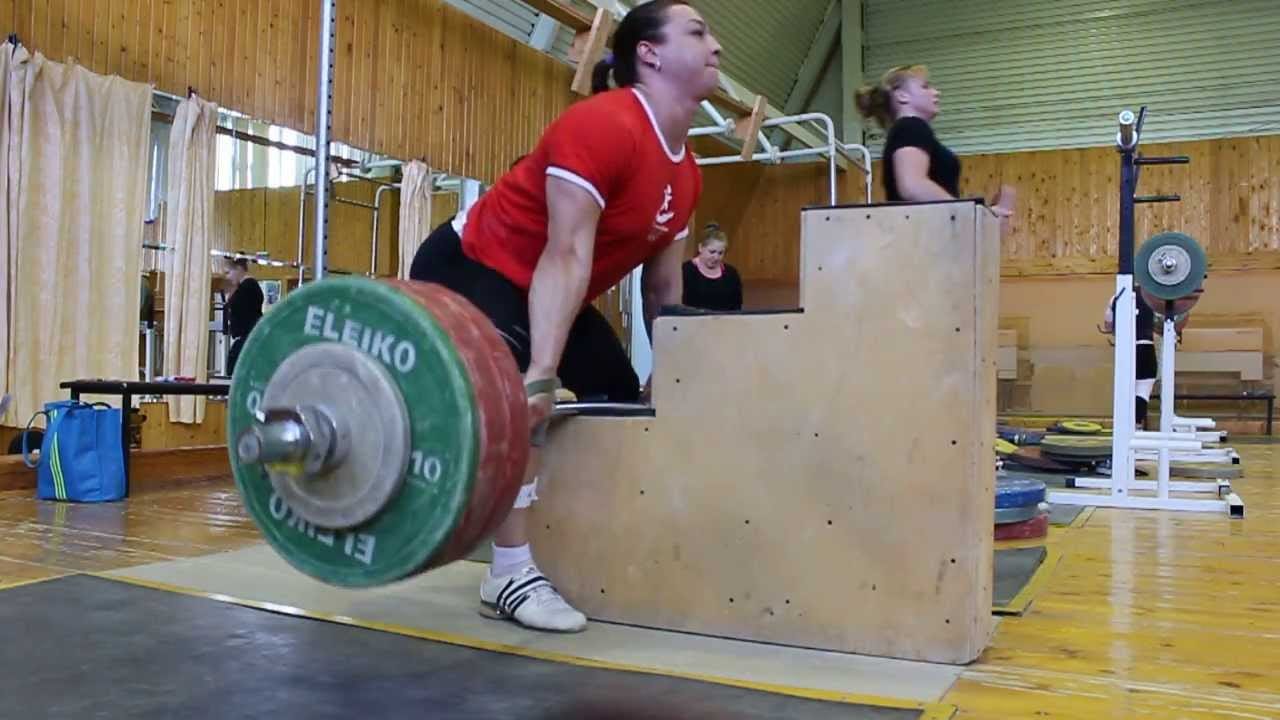
At the core of this system was the concept of special exercises: movements that isolate specific phases or positions of the competition lift to develop targeted strength qualities. Pulls from blocks, hang positions, and partial squats were (and still are) deliberately programmed to address specific weaknesses in the lifter’s technique or force production.
The Russians understood that the snatch and clean & jerk have distinct phases, and each phase has different force requirements. A lifter weak off the floor needed different work than a lifter who struggled at the second pull. Partial movements allowed coaches to target those weaknesses directly.
This concept of special developmental exercises, movements that closely resemble the competition lift but modify one or two variables to target specific adaptations, forms the foundation of how I think about partial ROM training for powerlifting.
The question is not whether partial ROM training works. The question is why it works, when it works, and how to programme it for maximum transfer to competition performance.
The Mechanism
Strength is joint-angle specific.
Train at 90 degrees of knee flexion, and you’ll get stronger at 90 degrees. You won’t reliably get stronger at 45 degrees or 135 degrees. The transfer window is roughly ±10-20 degrees from your training position. Your nervous system literally changes its control strategy based on where in the range of motion you’re working.
This specificity is the entire point.
Every compound lift has a sticking point, a predictable position where bar speed slows and maximal attempts fail:
Squat: Around parallel, the transition from eccentric to concentric at approximately 90° knee flexion
Bench Press: 2-4 inches off the chest, where the stretch reflex diminishes
Deadlift: At or just below knee level, during the transition from knee-dominant to hip-dominant extension
The sticking point is where you fail. It’s where your force production is insufficient relative to the demands of the load. If you want to lift more weight, you need to produce more force at that specific position.
One route, to improve this is what we see more of online, working on technical refinement using pauses, tempo reps etc, and i think this has huge value to traing yourself to be discilplined with the mechanics of the lift to optimise force transfer, but there is also a side to th problem that could require a greater force output.
This is why partial ROM training exists. Not to avoid full range work. Not to inflate training numbers. To deliver a targeted stimulus to the exact position where you are weakest.
Supramaximal Loading
My approach to partial ROM training centres on one principle: if you want to produce more force at a specific angle, you need to expose that angle to loads heavier than you can handle through full ROM.
This is the Anderson philosophy. He wasn’t digging holes to avoid full squats. He was loading quarter squats with 100kg above his best full squat to develop force production capacity that would transfer when he eventually returned to full depth.
Think about it this way. On a board press or pin squat, you can handle significantly more weight than your competition max—often 10-40% more depending on the range. When you load a partial ROM with 100-120% of your competition 1RM, you’re teaching your nervous system to produce force at levels it has never experienced in that position. You’re overloading the angle-specific neural patterns that determine whether you make or miss the lift.
This is what I mean by supercharging the transfer. The partial is not a replacement for full ROM work. It’s a targeted overload that makes your sticking point stronger than it could become through competition lifts alone.
But there’s an important distinction here. To use partial ROM work effectively, you need to understand why you fail a lift—why the sticking point has developed at that specific angle in the first place.
Partial ROM training is highly effective if you already have a strong technical model. You’re using it to develop force outputs at specific ranges, built on top of a solid technical foundation. The technique is already there. You’re just adding horsepower at the positions where you need it most.
I believe it to be far less effective the other way around. If you’re failing at a specific angle because of a technical breakdown—losing position, shifting weight, inefficient bar path—then throwing supramaximal partials at the problem won’t fix it. You’ll just reinforce poor mechanics under heavier loads. Technique first. Force production second.
Practical Application
Before you programme partials, you need to know exactly where you fail.
Video analysis is non-negotiable. Film your competition lifts from consistent angles. Watch where bar speed decelerates on heavy attempts. Identify the precise position where maximal lifts stall or fail.
For most lifters:
Squat: The transition from eccentric to concentric at or just above parallel
Bench Press: 2-4 inches off the chest where stretch reflex diminishes
Deadlift: At or just below the knee during the transition from knee-dominant to hip-dominant extension
But individual variation exists. Grip width changes the bench sticking point. Stance width and bar position change the squat sticking point. Sumo versus conventional changes the deadlift sticking point entirely.
Once you’ve identified your sticking point, you can programme partials that directly address it.
Working Examples: Squat
Pin Squats at Parallel
Set the pins at or slightly below your competition depth, the exact position where you tend to stall. Descend under control, settle onto the pins for a brief pause (eliminating stretch reflex), then drive up.
Loading: 90-100% of competition 1RM initially, progressing to 100-110% as you adapt
Rep range: 1-3 reps
Purpose: Develop starting strength and force production at the exact sticking point position
Anderson Squats (Dead-Stop)
Similar to pin squats but starting from the bottom position. Walk into the rack, set up under the bar at your sticking point depth, and drive up from a dead stop.
Loading: 85-105% of competition 1RM
Rep range: 1-3 reps
Purpose: Pure concentric force development with zero stretch reflex contribution
Practical note: Pin and Anderson squats train the transition point directly. They don’t train the eccentric loading that precedes the sticking point in competition. Use them as targeted supplements, not replacements.
Working Examples: Bench Press
Board Presses
Board height determines the training effect:
1 board: Off-chest weakness (addresses the position ~2 inches from chest)
2-3 boards: Mid-range sticking point (most common weak point for raw lifters)
4+ boards: Lockout emphasis (more relevant for equipped lifting or triceps-dominant weaknesses)
The higher you go on the boards, the more you shift emphasis to the triceps. Research on EMG activation during partial bench pressing shows upper-half ROM produces significantly higher triceps activation (56-57%) compared to full ROM (36-40%). Board work is targeted overload of specific muscle groups at specific positions.
Loading: 100-120% of competition 1RM depending on board height
Rep range: 1-5 reps
Purpose: Supramaximal exposure at the sticking point position
Dead Stop Pin Press
Set the pins at your sticking point height—typically 2-4 inches off the chest. Lower the bar to the pins, let it settle (eliminating stretch reflex), then press. The same principle as pin squats applied to the bench.
Loading: 95-110% of competition 1RM
Rep range: 3-5 reps
Purpose: Force production from a dead stop at the exact sticking point position
Working Examples: Deadlift
The deadlift presents a transfer problem that the squat and bench don’t share to the same degree.
Multiple coaches, and trainers have noted that rack pulls and block pulls don’t always transfer well to competition deadlifts. The mechanics of pulling from an elevated position differ from pulling from the floor. Hip position, back angle, and the relationship between knee and hip extension all change when you remove the initial pull off the floor.
Above-knee rack pulls are particularly problematic. The position is so different from competition pulling that the movement becomes a separate exercise rather than a targeted partial. This is potentially were ego has taken over, a very high rack pull obove the knee may not be indicated in many lifters sticking point analysis, and if it were you may revert back to technical issues earlier in the lift as opposed to force deficits (although there is another newsletter on this particular topic I’m sure) partial ROM works more effectively buult on a strong techncial model.
Understanding what you are and aren’t doing in terms of joint angles and leverages is important.
Block Pulls (Below Knee)
If you’re going to use partial deadlifts, position the bar below the knee—as close to the sticking point as possible while maintaining mechanics that resemble the competition lift.
Loading: 90-105% of competition 1RM
Rep range: 3-5 reps
Purpose: Overload the knee-level transition point
Programming Partial ROM Work
Partial ROM training belongs in intensification and peaking phases, after movement quality is established through full ROM accumulation work.
Assuming you train each lift multiple times per week, there are two ways to slot partial ROM work into your programme:
Option 1: Partial as Primary Exercise
Dedicate one session per week to the partial variation as your main lift. You’re chasing heavy singles or doubles at RPE 9-10.
Loading: 90-120% of competition 1RM (depending on ROM)
Rep range: 1-3 reps
Sets: 1-3 working sets after build-up
Purpose: Maximal force production, neural overload
Option 2: Partial as Secondary Exercise
Use the partial as a developmental lift after your competition exercise in the same session. Competition lift first to maintain movement integrity, partial second to deliver targeted overload. Slightly lower intensity, higher volume.
Loading: 80-90% of competition 1RM
Rep range: 3-5 reps
Sets: 3-5 working sets
Purpose: Repeated exposure to sticking point position, accumulation of quality reps at challenging loads
Both approaches work. The first is more CNS-intensive and suits lifters who respond well to heavy singles. The second spreads the stimulus across more reps and may suit lifters who need volume to drive adaptation. I tend to use the secondary approach more often in coachinng competition lift first, partial second, because it keeps the full ROM pattern sharp while still delivering the targeted overload. Ironically for my own trainnig I would find the first option has more carryover, but that is likely down to a few factors related to how I currently train.
P.S. If you found this breakdown useful and know another lifter who could benefit from understanding when and how to use partial work, please share. And if you’re not already subscribed to The Sticking Point, make sure you don’t miss the next article.