

You'll Know When You're Ready
A view of readiness to perform and the cost pushing on the wrong day

In his book Gold Rush, Michael Johnson describes a training session one week before the 1996 Atlanta Olympics. He’d already set the 200m world record at 19.66 seconds a month earlier. The final week wasn’t about pushing hard. It was about staying sharp and letting the body rest.
The session called for three 200-metre intervals at 23-second pace. Johnson used a timing system called ‘the beeper’ that sounded at set intervals, like a metronome for sprinting. It told him whether he was on pace, ahead, or behind.
On the first interval, he noticed he was ahead of the beeper at every cone. He relaxed, tried to slow down, and still crossed the line 1.5 seconds fast. 21.5 seconds. In flats. Not spikes.
His coach, Clyde Hart, said nothing. Normally he’d tell Johnson to get back on pace. This time he stayed silent.
The second interval was the same story. Johnson adjusted down, started less aggressively, and still came through 1.5 seconds ahead. Coach said nothing again. Johnson felt good. He realised he was fitter than he had ever been. With the final interval coming up in less than 90 seconds, he knew he could run it in 20 seconds if he wanted to. He wouldn’t. They never ran full speed in training. But the capacity was there.
The third interval felt effortless. He ran just under full effort and the gap to the beeper grew at every cone. 2.5 seconds ahead by his count.
Afterwards, Coach didn’t walk over to debrief like he normally would. Instead, he walked into the office under the stands and came back with his training log. ‘Start your cool down,’ he said. Then he showed Johnson the stopwatch. The actual times were 21.4, 21.2 and 20.1. ‘And you weren’t wearing spikes,’ he said.
No celebration. No excitement. Their attitude was that Johnson had done what he was capable of, so that’s what they should have expected. But they both agreed it confirmed he was ready to do something special in Atlanta the following week.
‘The hay is in the barn,’ Coach said. ‘We’re ready.’
The Readiness Signal
When I read that story, I don’t immediately stand in awe of the golds and the world records. They are remarkable. But what stays with me is process. Readiness building quietly over months. A coach and an athlete who understand each other deeply, who both know they are on the cusp of something extraordinary and neither gets ahead of themselves. No urge to prove it. No manufactured hype. It is just training, after all.
That restraint is what made Atlanta possible. Coach Hart didn’t need Johnson to run a world record in competition setup. The effortless pace ahead of the beeper, the capacity to run 20 seconds after two hard intervals, the quiet confidence through the session. All of it pointed in the same direction. Holding back kept that performance available for when it counted.
The same principle applies to your training. You don’t need a PB attempt two weeks out to confirm you’re ready. The signals are already in your body of work, if you know where to look.
How Readiness Shows Up
Readiness signals accumulate. They don’t announce themselves with a single data point. You’re looking for convergence across multiple streams of evidence.
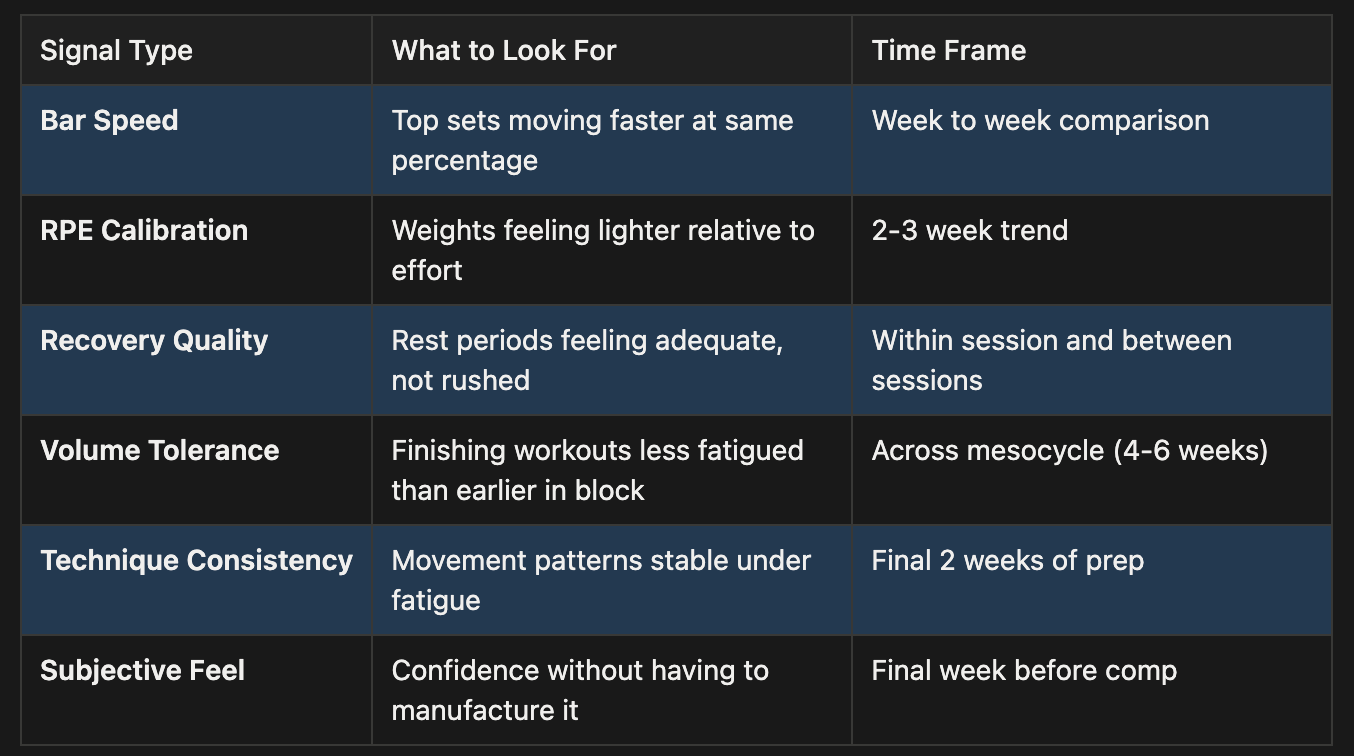
None of these require a max attempt. All of them tell you more than a single heavy lift ever could.
Where You Spend It Matters
Johnson knew he could run 20 seconds on that third interval. He chose not to. That decision is easy to overlook because the story ends with a gold medal. But the gold and world record happened because of the decision.
This is where most lifters lose the plot. You feel strong. Your training is going well. The signals are converging. And then you do something stupid with it.
You load up a heavy single three weeks out and film it for Instagram. You hit a gym PB at RPE 10 and post the reel with “comp prep going well” and a fire emoji. You treat the training floor like the platform because the validation is immediate and the audience is right there in your pocket.
That single costs you, and if you live my the maxim that ALL training comes at a cost and you just need to understand what that cost is you may then think it wasn't really worth it. The extra recovery now required. The cost of doing something your body has never done before.
Your taper is now shorter than planned, your fatigue hasn’t resolved on schedule, and the performance you were building toward has been partially spent in a room where nobody was judging.
A like on a training reel is not 3 whites..
Every time you go to a true max in training, you are choosing to express your fitness in a place where it earns you nothing. Let’s say you hit 95% and it feels heavy. Now you’re second-guessing your opener. Or you hit 95% and it flies. Now you’re considering inflating your third attempt. Either way, you’ve introduced noise into a signal that was clean. Six weeks of consistent training data told you everything you needed to know. One heavy single just traded that clarity for doubt or overconfidence.
The restraint to hold back when you know you have more is a skill. Most lifters never develop it because the short-term reward of proving it is too tempting. Johnson could have run 20 seconds flat in flats, one week out, and the story would have been incredible. Coach Hart would have had an unbelievable data point. But the 19.32 that happened in Atlanta the following week might not have.
If the signals are there, protect them. The platform is where you spend it.
Practical Application: Building Readiness Awareness
If you want to know when you’re ready without testing, you need to build the habit of tracking the signals that matter.
Start with bar speed. You don’t need dedicated VBT equipment for this. Your phone can do the job. Record your top sets across a mesocycle. Watch the same percentage move across Weeks 1, 3, and 5 of an accumulation block. If Week 5 looks faster than Week 1 at the same load, you’re adapting. If it looks the same or slower, you’re not recovering.
Track RPE honestly. This requires calibration, and most lifters are terrible at it early in their career. An RIR 2 set means you could have done 2 more reps with the same technique and bar speed. Not 2 more grinders. Not 2 more reps if someone held a gun to your head. Two clean reps. If your training prescribes RIR 2 and you’re logging it as RIR 2 but actually stopping at RIR 4, you’re underloading. If you’re logging RIR 2 but going to failure, you’re overreaching. Either way, the signal is corrupted.
Monitor session fatigue. This is subjective but valuable. At the end of Week 6 of an accumulation phase, you should feel less wrecked than you did at the end of Week 3, even though total volume is similar. If you don’t, something is wrong. You’re either not eating enough, not sleeping enough, or accumulating external stress that training is adding to rather than offsetting.
Pay attention to technique under load. In the final two weeks before a competition, your movement patterns should be stable. The bar path should look the same at 70% as it does at 85%. If technique starts breaking down at moderate loads, you’re either too fatigued or you have a technical inefficiency that needs addressing. Either way, it’s not the time to test a max.
The Hay Is in the Barn
Clyde Hart’s line to Michael Johnson captures everything about this principle. The hay is in the barn. The work is done. You don’t need to prove it. You just need to let it express itself when it matters.
In powerlifting, your competition performance is the test. Your training is the preparation. The moment you start treating training as the test, you’ve confused the two. You’ve spent the adaptation in the wrong place.
If you’ve followed a well-structured programme, executed the prescribed intensities honestly, eaten and slept appropriately, and managed external stress, the readiness signal will be obvious. Bar speed will increase. RPE will drop. Recovery will improve. Technique will stabilise. You’ll finish the final week of your taper feeling strong without needing to prove it.
That’s when you know.
Key Takeaways
Readiness signals accumulate across training. Bar speed, RPE calibration, recovery quality, and volume tolerance tell you more than a single max attempt ever could.
Track the signals that matter. Bar speed across a mesocycle, honest RPE logging, session fatigue trends, and technique stability under load. The data is already there.
Where you spend your best performance matters. A training reel is not the platform. Every max attempt in the gym is fitness expressed in a room where it earns you nothing.
Restraint is a skill. The ability to hold back when you know you have more is what separates lifters who peak on the platform from lifters who peak on Instagram.
The money is in the bank. When the work is done, the work is done. Protect it. Let it express itself where it counts.
P.S. If you’re struggling to recognise your own readiness signals, or you’re a coach working with lifters who constantly want to test, I’d love to help. Visit our website to schedule a consultation where we can discuss your specific programming and how to build better awareness of the signals that actually matter.
And if you found this week’s newsletter valuable, please share it with someone who needs to read it. Don’t forget to subscribe.